
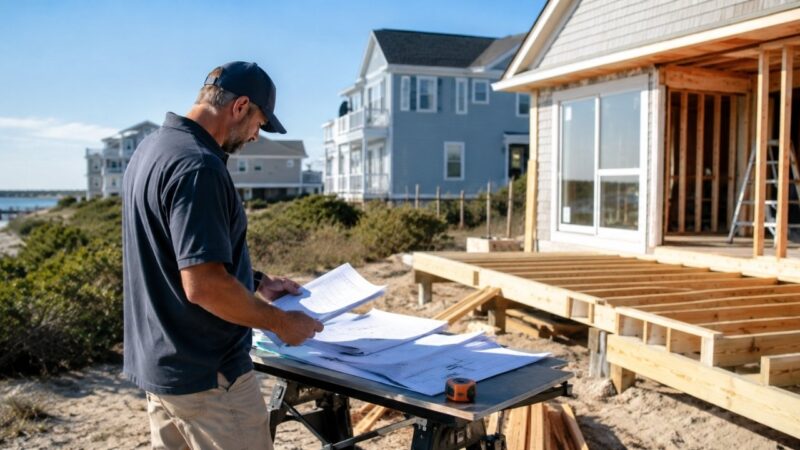
If you are planning a deck, an addition, or a full remodel in Virginia Beach, the permit fee itself is rarely the number that hurts. Most residential building permits in this city land between $57 and a few hundred dollars. Really.
The paperwork costs you more time than money. What does get expensive is skipping the step, so here is the actual fee schedule, the add-ons nobody warns you about, and what building without a permit ends up costing a homeowner here.
So What Does a Permit Actually Cost?
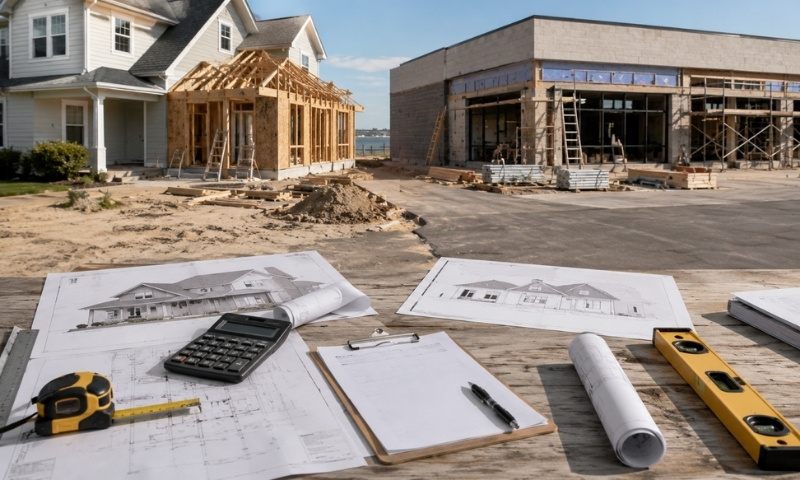
Virginia Beach does not use one flat rate. The Permits and Inspections Division prices your permit off either the square footage you are adding or the dollar value of the work.
Both formulas start at $50, and both are published openly, which means you can estimate your own cost before you ever call the city.
Residential Projects
Heated living space, whether it is a new house or an addition, is assessed at $50 plus $7 per 100 square feet. A 400 square foot bump-out comes to $78.
Unheated space is cheaper at $50 plus $4 per 100 square feet, putting a 600 square foot detached garage at $74.
Remodels use a different math entirely: $50 plus $5 per $1,000 of construction value, so a $10,000 kitchen job is $100. The city’s residential fee sheet lists every bracket.
Roofing and siding have their own schedule at the same $5 per $1,000 rate, which caps a $12,000 roof replacement at $110. If you own one of those older Virginia houses with three decades of repairs layered on top of each other, the surprises will come from the inspection, not the fee.
Commercial Projects
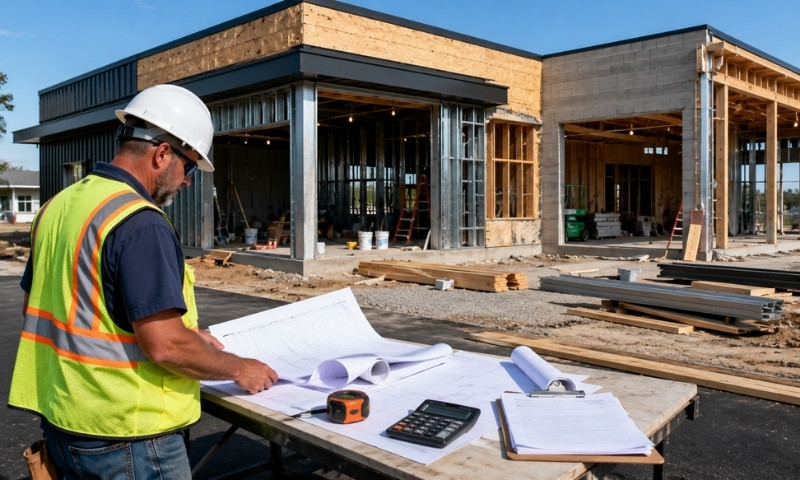
New commercial buildings and additions run $50 plus $8 per 100 square feet, while unheated commercial storage drops back to $50 plus $4. Commercial alterations follow the same $5 per $1,000 rule as residential.
A 1,000 square foot retail shell lands at $130, which is almost nothing next to the rest of a buildout budget. Owners financing energy upgrades through C-PACE programs usually find the permit line item is the smallest one on the page.
Virginia Beach Permit Fees at a Glance
| Project Type | How the Fee Is Calculated | Example Cost |
| Heated residential addition | $50 plus $7 per 100 sq ft | 400 sq ft = $78 |
| Non-heated residential (garage, shed) | $50 plus $4 per 100 sq ft | 600 sq ft = $74 |
| Residential alteration or remodel | $50 plus $5 per $1,000 of value | $10,000 job = $100 |
| Roofing or siding | $50 plus $5 per $1,000 of value | $12,000 roof = $110 |
| New commercial or commercial addition | $50 plus $8 per 100 sq ft | 1,000 sq ft = $130 |
| Commercial alteration | $50 plus $5 per $1,000 of value | $8,000 buildout = $90 |
| Demolition | $50 per structure | One garage = $50 |
What Needs a Building Permit in Virginia Beach
This is where people get tripped up, because the list is broader than most homeowners expect. The city requires a permit any time you cut into a wall, remove or cut a structural beam, or change anything that affects how people exit the building. Change of use counts too. So does a surprising amount of ordinary weekend work.
According to the city’s residential permit requirements, you need one for:
- Converting a garage or screened porch into living space
- Foundation repairs, chimneys, and roofing or siding replacement
- Replacing windows or exterior doors if the frames or jambs are altered
- Decks, driveways and driveway aprons, fences, and carports
- Detached structures larger than 256 square feet
- Pools and hot tubs that hold at least 24 inches of water
- Waterfront work such as bulkheads, piers, boat lifts, and rip rap
Anything inside the Chesapeake Bay Preservation Area or Southern Watershed Area may need a permit no matter how small it is. Demolition and moving a lot line that affects an existing structure both require one as well. Commercial properties follow a nearly identical list, according to the official site.
Almost every application asks for a site plan approved by the Zoning Office, and that catches people who have never had one drawn. If your property does not have one on file, a site plan service from Get A Site Plan can produce a drawing that meets what the reviewer is looking for.
The Add-On Fees Nobody Mentions
Your base permit fee is not your total. There are three layers stacked on top, and together they can double a small permit.
Plan Review Deposits
Residential plan review is $100, dropping to $25 for counter reviews and $25 for revisions. Commercial review is $200, with minor reviews at $100 and revisions at $100. Special use and occupancy review is $400. Every correction cycle you trigger is another fee, which is a decent argument for getting the drawings right the first time.
Trade Permits
Electrical, plumbing, gas, and mechanical work are permitted separately. A new 200 amp single phase electrical service is $130, while a service change up to 200 amps is $65. Added circuits are $50 plus $5 each, according to Planning and Community site of Virgina Beach.
The Levy, the Tech Fee, and the Certificate
A 2 percent state levy applies to every permit fee listed above, and a $10 technology fee is assessed on all permits. A certificate of occupancy is $75. A failed inspection means a $75 re-inspection fee. These are small individually and noticeable together, especially if you are already stretching to cover what a home costs in Virginia right now.
What Building Without a Permit Really Costs
Here is the part worth reading twice. Virginia Beach charges a flat $250 administrative fee for beginning work without a permit, and that fee appears on the residential sheet, the commercial sheet, the demolition schedule, and the trade schedule. You still pay the normal permit cost afterward. The $250 is simply a penalty for starting early.
The state adds its own teeth. Under Virginia Code section 36-106, violating the Uniform Statewide Building Code is a misdemeanor punishable by a fine of up to $2,500, and if the violation is uncorrected at conviction the court orders you to fix it, usually within six months.
Each day the problem continues past the abatement period counts as a separate offense.
Then come the quieter consequences. Building without a permit shows up during a sale, when a buyer’s agent asks for records that do not exist. Insurers have denied claims on unpermitted work.
Appraisers sometimes refuse to count the square footage at all, which is a real problem for anyone renting to visitors and depending on the Virginia Beach travel economy.
And the worst case is not a fine. Inspectors can require you to open finished walls so hidden work can be checked, or remove the structure entirely. Building without a permit turns a $78 permit into a demolition invoice, which is a rough trade.
How Long Does It Take?
Initial review for online submissions takes 15 to 45 business days according to the Permits and Inspections Division cited above, and revisions take roughly half of that. Small plan sets qualify for counter review: residential additions or alterations of 500 square feet or less, accessory structures under 500 square feet, uncovered decks of any size, and plan sets of five pages or fewer.
Frequently Asked Questions
Final Thoughts
Permits in Virginia Beach are cheap. A deck runs under $100, a kitchen remodel is about the same, and even a commercial buildout rarely breaks a few hundred dollars once the levy and tech fee are added.
The math only turns ugly when the permit is skipped, because if you don’t have a building permit , costs stack a $250 penalty onto a fee you were always going to pay anyway. Pull the paperwork, wait out the review window, and get on with the actual project.
References:
https://s3.us-east-1.amazonaws.com/virginia-beach-departments-docs/planning/Divisions-Offices/Permits_Inspections/Documents/Residential-Permit-Fees.pdf
https://planning.virginiabeach.gov/
https://law.lis.virginia.gov/vacode/title36/chapter6/section36-106/